In 1203 (1), magi of the Order made a promising discovery: a Magic regio with very unusual properties. First, it can be reached by several different regios on Earth rather than just one. Second, it has a very strong aura and isolated pockets where the aura is even higher, without breaking into another regio. Finally, and most spectacularly, it is a miniature replica of the cosmos beyond the lunar sphere, with seven island-sized "planets" circling in a watery sea around a central and inaccessible "Earth". The place, currently kept a secret by House leaders and archmagi, has been dubbed "Etheria." Several groups of magi have, with the blessing of these leaders, established hidden covenants in Etheria with an eye towards officially establishing an "Ethereal Tribunal" in 1223, at the next Grand Tribunal.
Magi of the Order cannot explain Etheria's unusual properties, especially the fact that it appears to connect to multiple weaker regios. (2) For example, regios already known at Stonehenge and at the Great Pyramid in Egypt provide access to Etheria from their highest levels. A few other access points are known, scattered widely across the world, no more than one in each Tribunal of the Order. This quality makes Etheria a potential travel route for those able to safely navigate both Etheria itself and the regios it connects to. Etheria's aura is also highly unusual; most of the regio has a Magic aura of 6, but this rises as high as 9 in a few locales. Ordinarily, when the aura within a regio rises, a new regio is formed, but Etheria has no other regios inside it or "above" it.
The landscape and geography of Etheria is utterly fantastic. At the center is an enormous island which replicates the habitable region of the world (Asia, Europe and Africa) in miniature. No one has been able to get a good look at this island, because all who approach are cast out of the regio and appear at the edge of the real world. This central "Earth" is circled by seven smaller islands, each of which represents, in miniature, one of the planets, with the Moon closest to the center, followed by the Sun, Mercury, Venus, Mars, Jupiter and Saturn. The islands are not especially large; there are few locations on them which could not be reached in a day's hard travel. A black dome of the fixed stars covers all of Etheria and, since there is no "sun" in the sky, it is always night there. The sea which surrounds the islands appears pitch black and marked by stars, but this is an illusion; in fact, the sphere of the fixed stars continues beneath the sea and is perceptible through the perfectly clear and transparent water. This sea, dubbed the "Twilight Sea," is exceptionally dangerous for magi, prompting episodes of twilight in those caught within it.
The islands, while of fabulous geography, are nevertheless habitable. For example, the surface of the "Sun" does indeed burn with perpetual fire, but there is at least one mountain peak which rises above the flames. The beaches are cooled by contact with the sea and the fire is extinguished wherever streams and lakes are found. When the aura rises on these islands, that aura is always aligned to the sorts of activities associated with the proper planetary body. For example, the stronger auras on the Isle of the Moon are aligned to magic of emotion, the tides, cyclic magic, fertility, and childbirth. (3)
Magi initially discovered Etheria in 1203 after sailing from the Great Pyramid's regio in Egypt. They made a brief survey before turning their boat for the central island and being forced out of the regio. One magi and his grogs had asked to stay behind on an island to explore and, when the boat did not return for him, he eventually led his group through another exit from the regio, emerging in the circle of Stonehenge in Britain. It was not until these two stories were brought together that the possibilities inherent in Etheria began to be recognized. The explorers approached an Archmage and asked his advice; he in turn contacted those House leaders whom he knew, and a brief conference followed, conducted through magic. Eventually, all thirteen leaders (4) of the various Houses and several archmagi were told about Etheria, though more than a few of these considered the place nothing but an interesting curiosity.
Perhaps because of this lack of interest, another faction prevailed with the argument that Etheria might prove to be a huge boon to the Order. For one, the high aura made it a lucrative place to gather vis. Second, the multiple routes of access suggested that it might be a way for magi, companions and grogs to move rapidly across the world without requiring vis or complex rituals. Finally, the regio's enormous size suggested it could host multiple covenants. Indeed, each island could comfortably house magi, resulting in an "Ethereal Tribunal" entirely within the boundaries of the regio! Such a place would be invulnerable to attack from the Order's enemies, it would not suffer from the encroaching aura of the Dominion, there are no Faeries or mundane lords to get in the way, and even the Infernal seems to be absent. In short, it is a magical paradise.
Ultimately it was decided that Etheria should be explored, but to ensure that no House came to dominate it, no covenant established there could have more than a single magus from a given House. If four covenants could be established by 1223, the Ethereal Tribunal would be formed. Regardless, the existence of Etheria would be revealed to the entire Order at that time. Besides establishing safe covenants, the other priority for the magi in Etheria is research into the nature of the regio itself. In particular, the Order must know if it is stable. If Etheria is "collapsing" down towards lower level auras, or "rising" up to the Magic Realm, this will cause catastrophic damage to magi and covenants located there. An Ethereal Tribunal is only practical if the regio is stable and, even then, it might be of limited life.
The initial explorers of Etheria include those magi who first discovered it, as well as select others chosen for the task by the leaders of the Houses and a few archmagi. Obviously, personal favoritism was a powerful factor, with many magi choosing their own former apprentices or close allies. In particular, several magi from the Greater Alps Tribunal became involved in the effort, since Etheria is perhaps the only place ever discovered which is even more remote than the Greater Alps already is. Moreover, there is no room for new magi in the Greater Alps, where the peripheral code forces all magi out to new Tribunals. Magi from the Stonehenge and Levant Tribunals are represented because they have easier access, but other entrances to the regio have been found, roughly one in each Tribunal.
Because there are no fey here, House Merinita has little interest in it; likewise, House Jerbiton is poorly represented, preferring to focus on mundane organizations like the Church and nobility, and House Ex Miscellanea has expressed little interest. While Etheria is populated by occasional Magical spirits and beasts, there are no ordinary animals here, and House Bjornaer has little involvement with the project. In contrast, there is strong representation from Houses Bonisagus, Verditius, and Criamon. House Tytalus, in particular, seems to think Etheria is far too docile and quiet, and needs a good shaking up before it will be useful. At least one Guernicus has been attached to the project as Quaesitor, and the Redcap network is setting up in the regio, using a variety of means to safely travel not only over the Twilight Sea but back and forth to the mundane world.
Companions in Etheria are generally chosen for a supernatural ability aligned to Magic; the high aura of Etheria ensures warping for all others who live there. Some magi keep their grogs in Etheria for only half the year before sending them home, thereby avoiding warping, but other magi don't find warping in grogs to be especially important. One of the first steps in the exploration was the construction of several boats which would be able to safely sail the Twilight Sea. Vis sources have been found there, usually aspected by the island where the vis is found. Thus, the Isle of the Sun is the primary source of ignem vis in Etheria, and this has prompted trading and cooperation among the various fledgling covenants.(5)
Etheria is not without its dangers, or its inhabitants. In particular, each Isle is ruled by a planetary spirit of high Magical Might, and attended by a host of other magical beings. Relations with these entities is a primary concern for the covenants forming there. The fabulous terrain has presented many challenges, and of course the scheming of Hermetic magi is ever present, pitting some covenants within the Tribunal against each other. The strong aura throughout the regio makes botches both likely and dangerous. In some senses, the magi of Etheria are their own worst enemy.
More to Come: Character Creation Guidelines and other Rule Considerations
----------
(1) The dating for the Ethereal Tribunal was calculated with the following premise: one season advances in the setting for every week of real time and, with a few weeks left over for vacation and holiday, that means one year passes in the game for every month in real time. Google+ launched in June of 2011, roughly 18 months ago. If the formation of the Community, roughly a month ago, occurred in 1220, the generic campaign start date for AM, that means Etheria was discovered seventeen years previous, and it is currently 1221 in the setting. The Grand Tribunal establishing the Ethereal Tribunal will occur in two years, or roughly March 2013 in real time.
(2) The Order has not yet agreed on an explanation for Etheria's bizarre properties. Partly, this is because it has been kept a secret from all but a small number of magi. Once its existence is revealed at the Grand Tribunal, a better explanation may be found. For now, the prevailing theory is that Etheria is a fragment of the Magic Realm (a cosm or insula) which somehow "broke off". Some argue this would be impossible. Others argue that this definition already describes all Magic regios. See Realms of Power: Magic p. 18-19 for more on cosms and insulae.
(3) For the magical associations of the seven planets, see "Planetary Magic," p. 57 of "The Mysteries: Revised Edition".
(4) Thirteen because House Tytalus has two praecos vying for dominance.
(5) I tried to assign particular flavors of vis to the seven planets, and while some were easy, others were hard or impossible, and it felt forced and unbalanced. So instead I figure some flavors are just more common on some islands than others.
Monday, January 14, 2013
The Ethereal Tribunal
Wednesday, September 5, 2012
Arthurian Legend and Guild Wars 2
So it was while I was surfing for the next game that I would try that I stumbled over an interview with the creators of Guild Wars 2 and, in a conversation about the new race in the game, I read that the Sylvari's stories were explicitly informed by Arthurian legend. They threw red meat at me, and I had to respond. Challenge accepted.
I've spent a couple of weeks in the game now, and much of that time has been spent on a Sylvari warrior, exploring Arthurian themes in the game. Are there, in fact, Arthurian themes in this game? How are they used and portrayed? Are they more than token gestures? To what extent are stories the Sylvari tell in harmony with the stories Malory and others told? These are the questions I am eager to answer, and I thought I would focus on one specific story at the beginning of the game, at least today. That is the story of the Green Knight.
Now, in modern re-interpretations of the Green Knight, there has been a great effort to portray him as an environmentally-aware character, sometimes a guardian of the forest or even as a supernaturally empowered avatar of nature. (See, for example, Marvel UK's Knights of Pendragon.) That is, the Green Knight is, politically, Green. He recycles.
None of that is in the myth. The story of Sir Gawaine and the Green Knight survives in one manuscript written in the 15th century by an anonymous poet who may have also written the religiously themes poems "Pearl", "Patience", and "Cleanness". For those who have not read it, I really do recommend it. It is not terribly long and will take you only a couple of hours. It has been translated from a northern dialect of Middle English into modern English by many people over the years, but for sheer nerd value you really ought to read the one by JRR Tolkien, he of the hobbits and the wizards, who of course was also an Oxford language professor.
In the poem, Gawaine -- who is the paragon of courtly and chivalrous behavior, not the rude murderer he is in Malory -- is hanging out with his uncle Arthur and the Queen in Camelot when they are interrupted by a mysterious intruder who is dressed and painted entirely green. (Even his beard is green!) The Knight issues a challenge, the beheading game, which is an old trope in legend and myth. No one is willing to take the challenge except for Gawaine, who accepts the offer to take a swing at the Knight's head if, when he is done, the Knight gets a return stroke. Gawaine does well, cutting off the head, but the magic is revealed when the Knight walks over, picks up his head, and puts it back on. Now Gawaine must let the return stoke be swung, but the Knight gives him a year to put his things in order before -- presumably -- he will be executed. After commanding Gawaine to come to "the Green Chapel" in a year for the end of the contest, the Knight rides off.
Gawaine wastes the year partying and hanging out with the court. Finally, with only weeks left, he rides off to look for the Green Chapel, coming to grips with the fact he is probably going to die. He cannot find the Chapel, however, until he stops at a castle belonging to one Sir Bercilak and his gorgeous wife. Bercilak knows where the Chapel is, and it's just a few hours away; Gawaine can stay at Bercilak's home for a few days and, on New Year's, ride to the Chapel. Gawaine, perhaps thanks to the lady's charm, good looks, and earnest appeal, agrees to stay.
Bercilak's hobby is hunting, but Gawaine wants to stay home with the hot wife, so they make a deal. (You'd think Gawaine would have learned, but whatever.) Bercilak agrees to give Gawaine everything he gets on the hunt, but Gawaine must agree to give everything he gets during the day, too. And you get the idea that this is no idle game, since, while Bercilak is away each day, his wife engages in an all out full court press to seduce Gawaine into sex. She finds him in his bed, cuddles up and kisses him, but he tells her no each day. Each of the first two nights, Bercilak comes back with the remains of some beast and gives it all to Gawaine, while the knight gives Bercilak a nice smooch on the lips: his own trophy for the day.
The real test comes the third day when Bercilak's wife reveals that she wears a sash which, so long as it is worn, keeps you from dying. She offers it to Gawaine and he, suddenly seeing a way out of certain death, accepts it. When he meets Bercilak that night, he gives him the kiss he got earlier in the day, but not the sash. That, he keeps for himself, and in so doing breaks his word.
Bercilak leads Gawaine out to the Green Chapel the next day and reveals that he, himself, is the Green Knight. Ready to claim Gawaine's head, he tells the knight to bend over and he makes two fake swings at Gawaine's neck, missing each time on purpose. But the third stroke nicks Gawaine's neck, drawing blood, and Bercilak explains that he knows everything that transpired with his wife during Gawaine's visit. Because Gawaine was honest on the first two days, Bercilak misses the neck, but because Gawaine lied on the third day, he got hurt. But it's only a scratch, instead of a death blow, because Gawaine's lie was understandable: the young knight did not want to die. And because he wanted to live, he lied. Who would not do the same? So Bercilak shows mercy, and Gawaine is humiliated but alive. He returns to Camelot and tells the story, leading Arthur and the court to adopt the wearing of green sashes which, for Gawaine, is a badge of his shame and his failure, but which for the king and court are just a fashion statement. It is worth noting that the story about the sash preventing you from harm is a lie: if Bercilak wanted, he could have killed Gawaine. The spell of invulnerability which Bercilak had was provided by Morgan le Fey, who is probably to be identified with an old woman who shows up once in the poem, accompanying Bercilak's wife.
Sylvari players are confronted with the green knight in their personal story; they can choose to have Dreamed of the Green Knight, a mysterious White Hart, or of the moon. (The White Hart is also an explicit Arthurian reference, which we will unpack another day.) The Knight, whose name is also Bercilak, has just slain Eladus, beloved of Dagdar, in battle. Eladus and Dagdar are both male but there seems little doubt of their romantic relationship when Dagdar refers to "my beloved". This homoerotic relationship stands out in the game because it comes so early; it is literally the first romantic relationship many Sylvari players encounter. But it's also a nice call-out to the homoerotic elements of the original story, in which Gawaine plants three lusty kisses on his host.
The player character's fight with Bercilak here echoes the Knight's first arrival in Camelot, with the PC triumphant but denied his victory due to magic; Bercilak cannot be killed. But the beheading game specifically is absent, replaced by a more traditional duel between knights (or "valiants", to use the Sylvari term). Rather than wasting a year at court before slowly finding his way to the rematch, the Guild Wars hero actively seeks out Bercilak and the source of his powers in order to deliver justice on a guy who is much less morally ambiguous and more clearly wicked than the source material.
The quest leads to a female Sylvari named Gairwen, a nice Gawaine reference. This Bercilak is not married, and is instead courting a female Sylvari whose (male) lover he has already slain. Arthurian myth has plenty of examples of knights killing a rival only to claim the rival's wife, so Bercilak can perhaps be excused for thinking Gairwen would fall head over heels for him. His inability to understand Gairwen's dislike echoes another famous Gawaine story, the tale of Dame Ragnell, in which Gawaine is sent questing to learn the answer to the question "What do women want?" (Chaucer told this story in the Wife of Bath's Tale, but he edited out Gawaine to make it about an anonymous knight.) The answer is that women want to call the shots, they want the power to decide their own destiny, rather than be forced to let men make the decisions for them. But Gairwen, though she resents Bercilak's attempts to force her, is quite willing to let the PC make the decisions. She tells us that Bercilak's invulnerability comes from his magic armor, a play on the idea that the green sash really does make you immune to harm.
This sends the PC off on a quest to find the smith who made the armor, a reference not to an explicitly Arthurian tale, but rather to Norse and Celtic tales of a godlike smith. Our smith is named Occam, presumably after Occam's Razor, which would be a cool name for a sword but which is actually a principle of logic and deduction which states that the simplest explanation is probably the correct one. Occam can be compared to characters like Weyland, the Norse smith who, in Mary Stewart's influential Arthurian novels, forged Excalibur. In our story, Occam fills the role of Morgan le Fey, the magical source for Bercilak's spell of invulnerability.
Occam has been kidnapped, which leads us back to Gairwen and a cunning plan: if we can trick Bercilak into kissing Gairwen -- an act which you all will recognize by now -- we can deprive him of his helmet and, thus, allow his head to be chopped off. This is a Reverse Green Knight: instead of a challenge in which we chop off Bercilak's head and he is not harmed, we instead have a rematch in which we chop off the head and it works. Gairwen is still grieving for her lost love, but she agrees and persuades Bercilak to kiss her before stealing the helmet. This leads to a pretty straight forward fight with a tough boss with a knockdown attack that, I cannot help but wonder, might be referencing Bercilak's requirement that Gawaine get down on his knees to accept the sword stroke. With Bercilak defeated, Gairwen moves in with the PC, which I found interesting. Sadly, there is no Green Sash costuming item from Bercilak. It's a real shame, and would make a wonderful memento of a fun quest chain. Perhaps it was left out because only those Sylvari who choose this personal quest chain would be able to get this reward. Regardless, I would have liked to see a green belt or chest piece awarded to those who defeat the Green Knight. This, by the way, is where the British Order of the Knights of the Garter come from: the garter is specifically a reference to the sash Gawaine wears.
The story of Bercilak the Green Knight of Guild Wars 2 is loosely inspired by the original poem, but owes more to that poem than to other, popular, conceptions of the Green Knight. In that sense, and in its uses of the kissing motif, of love between two men, and in its portrayal of a man who cannot understand why a woman would not enjoy being forced to have sex, the quest honors and plays with medieval source material. It's not as morally ambiguous as the original tale, and it recasts the whole business from a test of moral character to one of combat prowess, but this seems fitting considering how early in the game this story is encountered. There are hard choices which players must make in this game -- and in this story the player must choose to save Gairwen or Occam -- but trying to portray Gawaine's refusal to have sex with Bercilak's wife, and then his willingness to hide the garter from Bercilak himself, is perhaps a bit too nuanced for an action adventure game like GW2, especially when players might be experiencing the game for the first time on their first character.
Thursday, August 16, 2012
Georgia on my Mind
There is much to report since my last blog post, but a man must start somewhere. So, for now, I want to address all of my new students who might be furiously trying to Google their new professor and want to know, "Who is this guy and what is he doing in Georgia?"
My name is Jason Tondro and I am the newest English professor at the College of Coastal Georgia. CCGA is a school in transition, moving from a community college to a four year institution offering Bachelor degrees. I was very flattered to be invited to interview several months ago and even more delighted to be given the opportunity to come here. A lot of people have asked me, "Why Georgia?" Well, the true answer to that question is that I go where the work is. I loved Southern California -- I have friends and family there, and UC Riverside is just one sprawling comfort zone for me -- but this is a very bad time to be an educator in California. The cuts to the educational system are demoralizing and they hurt the students, which makes every day a kind of walking, talking tragedy. I was more than happy to leave an environment of disappointment.
Now, Georgia has its own financial questions to answer, and the Georgia state college system, of which CCGA is a part, is hardly made of money. But CCGA in particular is growing; it is building dormitories and student facilities, it is renovating classrooms and offices, it is creating programs instead of eliminating them. And that is where I want to be. So while the short answer was, "I go where the work is," the long answer is, "I go where I enjoy being." That these two places happen to be the same place is a stroke of good fortune to which I am not blind.
For those of you who are new to the blog and to me, my training and background is in Medieval and Renaissance literature (effectively everything in English from Beowulf to Milton) and in comics and graphic novels. My book, Superheroes of the Round Table, is about the ways in which superhero comics like Iron Man, Captain America, and the Justice League can help us read and understand more traditional texts like Shakespeare and Arthurian legend. It was enormous fun to write. I also have about a decade of experience teaching writing at the freshman level, in composition classes at many different universities and colleges. I'm a writer myself, not just of academic articles but of novels, short stories, poetry, blogs and more. I've written comic scripts and film scripts and many of them were very bad, but I learned a lot.
This semester I am teaching one section of ENG 1101, which is freshman composition, and one section of 1102, which is composition and literature. I have one traditional section of World Lit I, which is lit up to 1650 (Milton) and therefore precisely in my wheelhouse. I also have two online sections of the same class, so we will all be learning and experimenting there together in an attempt to not only master the material but also build some kind of student-teacher relationship. I don't want you to be only a number to me, and I presume and hope you do not want me to be merely a number to you.
Students looking to reach me can do so easily at jtondro@ccga.edu.
My name is Jason Tondro and I am the newest English professor at the College of Coastal Georgia. CCGA is a school in transition, moving from a community college to a four year institution offering Bachelor degrees. I was very flattered to be invited to interview several months ago and even more delighted to be given the opportunity to come here. A lot of people have asked me, "Why Georgia?" Well, the true answer to that question is that I go where the work is. I loved Southern California -- I have friends and family there, and UC Riverside is just one sprawling comfort zone for me -- but this is a very bad time to be an educator in California. The cuts to the educational system are demoralizing and they hurt the students, which makes every day a kind of walking, talking tragedy. I was more than happy to leave an environment of disappointment.
Now, Georgia has its own financial questions to answer, and the Georgia state college system, of which CCGA is a part, is hardly made of money. But CCGA in particular is growing; it is building dormitories and student facilities, it is renovating classrooms and offices, it is creating programs instead of eliminating them. And that is where I want to be. So while the short answer was, "I go where the work is," the long answer is, "I go where I enjoy being." That these two places happen to be the same place is a stroke of good fortune to which I am not blind.
For those of you who are new to the blog and to me, my training and background is in Medieval and Renaissance literature (effectively everything in English from Beowulf to Milton) and in comics and graphic novels. My book, Superheroes of the Round Table, is about the ways in which superhero comics like Iron Man, Captain America, and the Justice League can help us read and understand more traditional texts like Shakespeare and Arthurian legend. It was enormous fun to write. I also have about a decade of experience teaching writing at the freshman level, in composition classes at many different universities and colleges. I'm a writer myself, not just of academic articles but of novels, short stories, poetry, blogs and more. I've written comic scripts and film scripts and many of them were very bad, but I learned a lot.
This semester I am teaching one section of ENG 1101, which is freshman composition, and one section of 1102, which is composition and literature. I have one traditional section of World Lit I, which is lit up to 1650 (Milton) and therefore precisely in my wheelhouse. I also have two online sections of the same class, so we will all be learning and experimenting there together in an attempt to not only master the material but also build some kind of student-teacher relationship. I don't want you to be only a number to me, and I presume and hope you do not want me to be merely a number to you.
Students looking to reach me can do so easily at jtondro@ccga.edu.
Friday, April 20, 2012
Hand of Fire: The Comics Art of Jack Kirby
Anyway, my colleague's praise dwelt especially on Charles's prose, to which the adjective "soaring" was applied, and I am always interested in learning from good prose. So that night while we all had dinner, I logged on to Amazon and lo and behold there was a kindle edition for one fourth the price of the hardback. I am only halfway through the book right now, but it provokes a lot of reaction and I want to get some of that down now before I forget it in the second half.
Academics know better than to call anything "definitive", but if we think of definitive instead as a scale of increasing definitiveness, then Charles's book is positioned to be pretty far along that scale. And I was struck by this because, of course, Kirby is dead. That is, his career is entirely and "definitively" over. This is in contrast to, say, Alan Moore or Grant Morrison, who have also been the subjects of single-author monograms recently. No matter how good Marc's book is, or Annalisa Di Liddo's Alan Moore: Comics as Performance, Fiction as Scalpel, Moore and Morrison are still working, still creating, and in ten or twenty years someone else is going to put out a book that is informed by those authors' entire body of work, instead of "just" a few decades of it, and Marc or Annalisa's take on these authors will no longer be "definitive". Not that either author expects it to be, but as authors and scholars we do hope our take on a subject demonstrates staying power and longevity.
Charles, however, is writing from a more traditional lit crit vantage point: that is, his subject is dead. Like Shakespeare or Chaucer. But unlike those two subjects, the subject of Jack Kirby is still fresh in academic circles. Indeed, this is the first book length academic treatment of Kirby. And god knows we needed it. But when you add in these facts -- that Charles can write about Kirby's career as a totality rather than as a work in progress, and that Charles is basically writing in a field that is sparsely planted -- what we see is that Hand of Fire is positioned to be the definitive analysis of Jack Kirby for, oh, one academic generation. That is, until one of our current students, someone entering grad school in the Fall, decides to write a better book sometime around 2025.
Provided, of course, that the book does not suck. And it does not. There are a lot of things for me, personally, to like about this book. Let's get to a couple of them.
Hand of Fire is a big sloppy wet kiss to all of us who think that the author is still relevant. One of Charles's arguments -- and there are several -- is that Kirby's life experience, the shape of his career and the conditions under which he worked, had a huge influence over the art and stories he produced. Charles spends plenty of time doing textual analysis of Kirby's pages, looking at how they work and what they say, but he always does it in the context of the argument that these pages are expressions of Kirby's values, values shaped by very real forces which can be traced and outlined. I'm a historicist by training and this kind of argument goes a very long way with me. I'm not arguing that we can know what Kirby "meant" with any individual page, but I agree that we can come to a better understanding of these pages if we know where Kirby was at, personally, financially, and in a literary sense, when he made them.
Speaking of theory, Charles spends a lot of time writing about semiotics in this book, and that's one of the reasons I really like it. As the study of signs, semiotics is a natural partner to comics analysis and I am ashamed to admit I don't know as much about it as I should. But Charles shows a keen awareness of his reading audience when he walks us through semiotic theory, and an awareness of the audience is no less refreshing in a scholar's second book than it is in a freshman essay. Most of my academic life is spent teaching, and when Charles walks us through some of his classroom experiments teaching semiotics to his students, this is nourishing food to a starving man. It makes the book useful beyond its title. If Charles had "only" written an informed, articulate, and thorough examination of Kirby's art, that would still have been damn impressive. But it is also a practical handbook on how to teach semiotics theory in the classroom and how to put it into practice on the page. The first book was totally necessary; the second is an exciting surprise.
This book also surprises in its occasionally personal nature. Frankly, I did not expect Charles to have as clearly audible a voice as he has in this book. But I am glad it is there. In the course of reading, I have learned that Kamandi, Last Boy on Earth is Charles's favorite Kirby comic, one which he read as a child. I have learned that Charles really doesn't like modern superhero comics in the "realistic" mode, most especially the art of Alex Ross, which Charles targets for special disdain. An emphasis on the detailed heroic form, on the posed "picture" instead of on narrative drawing, has taken the life and drama out of the genre, he argues. I wonder what he would think of something like All-Star Superman, where Quitely's art definitely falls under the category of "hyper-detailed" without -- at least in my opinion -- sacrificing narrative power.
I'm only halfway through Hand of Fire. But this is a start, and as you can see, it has given me a lot to think about. Which is a good thing in and of itself.
My El Guapo
First, the big news: I begin work as a tenure-track Assistant Professor at the College of Coastal Georgia in the Fall. There's much to say about this felicitous turn of events, but for now I have to limit myself to, "The book worked." Because I had no illusions that I would sell tremendous quantities of Superheroes of the Round Table (168 at last count); I wrote that book to get a job.
But let's get to the real topic of this post: a big hairy guy who's out to kill us. Yes, I am talking about El Guapo. No, not that El Guapo, the one who got his legs blown off by a missile. I mean this El Guapo:
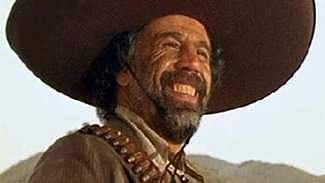
Lucky Day: I suppose you could say that everyone has an El Guapo. For some, shyness may be an El Guapo. For others, lack of education may be an El Guapo. But for us, El Guapo is a large ugly man who wants to kill us!
I don't think shyness is my El Guapo. And certainly a lack of education is not my El Guapo. For the people of Santa Poco, their El Guapo just happened to be the actual El Guapo. My El Guapo is Dr. Marc Singer.
Because Marc is neither ugly nor especially hairy, some explanation may be in order. I basically have a huge inferiority complex and Marc -- who is a genuinely swell guy and who is probably reading this -- has always been that guy who was smarter, funnier, more successful, and just better read than I am. And I have a deep and long lasting envy of the man. I suppose I could claim envy is my El Guapo but I can't think of anyone else I actually envy. Sorry, Marc. You're it.
What this means is that in my darkest moments -- and we all have them -- I bludgeon myself with the firm conviction that there are always going to be people who make me feel stupid. (I can admit to fears of failure now, when I have landed a good job.) Fortunately, Marc is such a stand up guy -- as you would expect my El Guapo to be -- that he remains always the gentleman and, in my brightest moments, I'm able to turn that envy into a motivating desire to succeed that makes me sometimes smarter and more articulate than I otherwise have any right to be.
All of which has led me to reconsider Geoff Klock's book How to Read Superheroes and Why. Now, this is a really well written book and a fun read for any fan of superhero comics because Geoff is wide ranging in his subject matter and the authors and characters he deals with. Where else are you going to read an academic book that analyzes WildCATS vs. Aliens? Nowhere else.
But although it is engagingly written, diverse in its material and ambitious in its scope, I have always kind of relegated the book to "Interesting but..." status because I disagreed with the fundamental theoretical foundation of the book, which is Harold Bloom's Anxiety of Influence argument. And if you are following along, you now see where this is going.
Bloom approaches literature with a (modified) Freudian perspective and argues that authors are essentially trying to one-up or out-do their artistic "fathers", whoever that might be. So, for example, Shakespeare's early career can best be understood -- Bloom argues -- by seeing it as Shakespeare's effort to surpass or break free of Marlowe. But Marlowe died young, freeing Shakespeare from his primary source of artistic anxiety, and this resulted in the more experimental and masterful Shakespeare we eventually got. In other words, Marlowe was Shakespeare's El Guapo.
Looking back on my own personal experiences, which are of course idiosyncratic and should not be extrapolated across a discipline, I have to admit I have felt my own "anxiety of influence" and, well, Bloom and Klock might be on to something. Academics are already well aware of the foolishness of trying to apply one theoretical lens to all texts in all situations, so I don't really need to caution against doing that, but taken in some moderation, seasoned with a recognition that influences are multiple, across the inner self and the outer social one, it seems equally silly to dismiss the anxiety a thinker feels because he has role models who are So Damn Smart.
Wednesday, October 12, 2011
The BAMF Podcast
Mike Lafferty, good friend and drunkard, hosted a podcast last evening and we had a couple of wonderful co-hosts including Green Ronin freelancer, political science professor, and cynic Chris McGlothlin, and IDW veteran and comic creator and game designer Dan Taylor.
I learned a lot, as I always do at these round tables. And we shared our thoughts on the latest round of DC comics. Both Dan and Chris had read far more of them than I had, but we still managed to find some gems and some duds.
Wednesday, October 5, 2011
The Book is Out
McFarland assures me an electronic version of the book will be available through Amazon, but there is no sign of it yet. In fact, Amazon still reports the book as coming out in January. But interested parties can buy directly from McFarland. When the digital copy comes out, I will spread the word.
Subscribe to:
Posts (Atom)