Wednesday, June 12, 2013

V for Vendetta and Alan Moore's Oeuvre

This, too, is the fault of Hannah Menzies. Hannah is working on a much-anticipated (by me, at least) book on Alan Moore the magus and as we sat in a panel a couple weeks ago in lovely Denver, she leaned back and casually asked, in that way of hers, "How do you think V fits into Moore's body of work?" I rattled off some top-of-my-head answer, but the truth is I have not been able to stop thinking about that question. I think it's a really good one.

Because if you think about it for half a minute, you could probably list a dozen ways in which V for Vendetta is unlike everything else Moore has written. Most obviously, it is an aggressively political work. At least on the surface, it seems to argue for a pretty specific agenda of armed revolution. This is one of the reasons students eventually get into it (once they get past the large cast of characters and Lloyd's art style), and it's one of the things emphasized in the big-screen Hollywood adaptation. Is there anything else in Moore's work which is as polemic as V for Vendetta? And the book's glamorization of the charismatic Great Man leader-hero is so much at odds with the rest of Moore's work that it kind of boggles the mind if you think about it. Even the little bits are tremendously out of character; one of my favorite bits from V is the short story called "Vincent," but it is hard to imagine the infamously-verbose Alan writing another story without any text at all.

I want to acknowledge from the get-go that this is an extremely problematic text, to use the academic slang. And by this, I mean to say this book is pretty fucked up. Imagine a scene, before this movie came out. Imagine a grad student trying to explain to his seminar how V kidnaps Evey, interrogates and tortures her, and when it is all over, she thanks him for it. Imagine the weird looks on everyone's face. Yeah. That was me, trying to explain the most problematic scene in V, back in about 2002.

It will never cease to be a mystery to me that the filmmakers kept that deeply troubling and problematic sequence for the film and then cut everything else, material which was not nearly as offensive, and replaced it with pap. In the film, Evey goes from being an aspiring prostitute working at a match factory (a match factory!) to a cog in a network media machine who is just out after curfew visiting her gay friend. And this is just one obvious example of the way V has been sanitized for a popular audience. But they kept the craziest scene, the scene that must have drawn them to the book in the first place, because it is just so grossly offensive.

But I maintain that the book does have a conscience, and that you can see that conscience at the end, when V enlists Finch to help him perform assisted suicide. V is a wicked man. He's doing some good things, but he remains a wicked man. And according to his own code of behavior, a man must be responsible for his own actions. And that means that the wicked must be punished, and V must die. He knows this. He has judged himself and found himself culpable, and he does not "die" at the end so much as "allow himself to be executed" -- by Finch, the good man who has done wicked things, by the real hero of the story who is V's mirror opposite. But Evey, who has rejected that way of life, deserves to live. And so live she does.

Some have argued that David Lloyd had far more influence over the book than Moore's other creative partners, and I recognize that Lloyd came up with things like the Guy Fawkes connection and so on, but I am not entirely convinced that we should just throw our hands up and blame Lloyd. Moore's collaborative process has had more light shed on it than many other creators and while he does seem to be the only person who writes his scripts, he's not been shy about giving credit to creators on Watchmen or elsewhere.

Let's try to get specific with the question: What does V have in common with Alan's other work?

It's Literate: V is a highly literate text and character. Indeed, at some points in the narrative, V for Vendetta seems to be about Art itself, if not about literature. This begins with V's opening speech from MacBeth, it continues through physical props like the Shadow Gallery and V's frequent quotes from culture high and low, to the theater, Valerie, and "Vaudeville," and finally to the Viking funeral. Perhaps it is better to say that, at times, V is about Artifice more than Art: it is about masks and drama, but that's not what I'm getting at here. What I'm trying to zero in on is the way Moore invokes everything from Shakespeare to the Stones as muses, as badges of honor. But it comes too early in Moore's life to have much (any?) reference to Blake, as From Hell, Promethea, and Angel Passage all do.

In the End, It's Optimistic: Readers don't usually associate this with Moore, but most of his work is affirmative and positive in its estimate of human nature, though it often requires us to work through a lot of crap to get there. Watchmen feels like a post-modern ode to deconstruction until suddenly, at the end, Dr. Manhattan comes to understand that every human being is a kind of miracle, that life is worth living, and that it takes us to strange places and makes us do crazy things. Reading From Hell feels like living in a claustrophobic meat locker, but by the time we reach the end, there's William Gull wheeling around as a confused and impotent ghost while Mary Kelly gives him the finger. A lot of the people in League are tortured and in pain, but ultimately the book is a celebration of creativity, of Art and imagination, of powers so potent and immortal that they outlast even their creators. And V has some really ugly, grubby, awful people in it. Sometimes it seems like there's no one in this book worth cheering for. But when Evey says, "Let it grow," she breaks out of that crappy world to become the best person in this book, and when she accepts the role of V, we at least know the nation is in good hands -- even if the charismatic hero-leader is an anomaly in Moore's book, and one we instinctively mistrust.

It's On Drugs: Seriously, Moore's experiences with LSD are public record and drug use informs multiple texts in his oeuvre, including Swamp Thing and virtually everything he wrote after he became a practicing magician, because hallucinogenic drugs are required for that trade (unless you are William Blake or, like him, see angels sitting on haybales without chemical assistance). The drug use in V is pretty self-contained and it enables a revelatory experience, Finch's epiphany, mirroring V's own and that which V inflicts on Evey. It is a very short jump from this to plant-sex with Swamp Thing.

It's Got Rape: As others (Grant Morrison is only the most notable) have noted long before me, Moore writes a lot about rape. Indeed, it can be a challenge to find one of his texts that does not have rape in it. Now, you can phrase this as, "Moore is obsessed with rape," or you can phrase it as, "The topic of rape is important to Moore," depending on how much of a pejorative you want this trait to be, but no matter how you say it, we have to acknowledge it's there, and V is no exception. The book starts with attempted rape and prostitution (another Moore theme, especially since he became a magus), acts no less central to the plot than the rape of Silk Spectre I or Janni Dakkar.

Personally, I find V for Vendetta a very teachable text. It works well in the classroom because it provokes discussion. There are inevitably some government-hating students in the class who get into it without thinking about it very much, the interrogation of Evey gives us a lot to think and talk about (including Aristotelean notions of catharsis, pity and fear), and the literacy of the entire book rewards close readers, who find additional meaning. YouTube videos of the song's musical numbers bring some great diversity to the classroom space. It uses symbolism and metaphor in some pretty rock solid ways. roses/Rose being only the neatest example. And it comes without a lot of the Cold War baggage that Watchmen brings. If I ever get the chance to teach a single author Alan Moore course, I am not sure I would include it. His early phase is perhaps better represented by something like Ballad of Halo Jones, and the completion of V for Vendetta was contemporaneous with Watchmen, which would presumably be on the syllabus. But when I only have time to teach one Moore comic, it's not a bad choice. 

Thursday, June 6, 2013

Religion and Superheroes


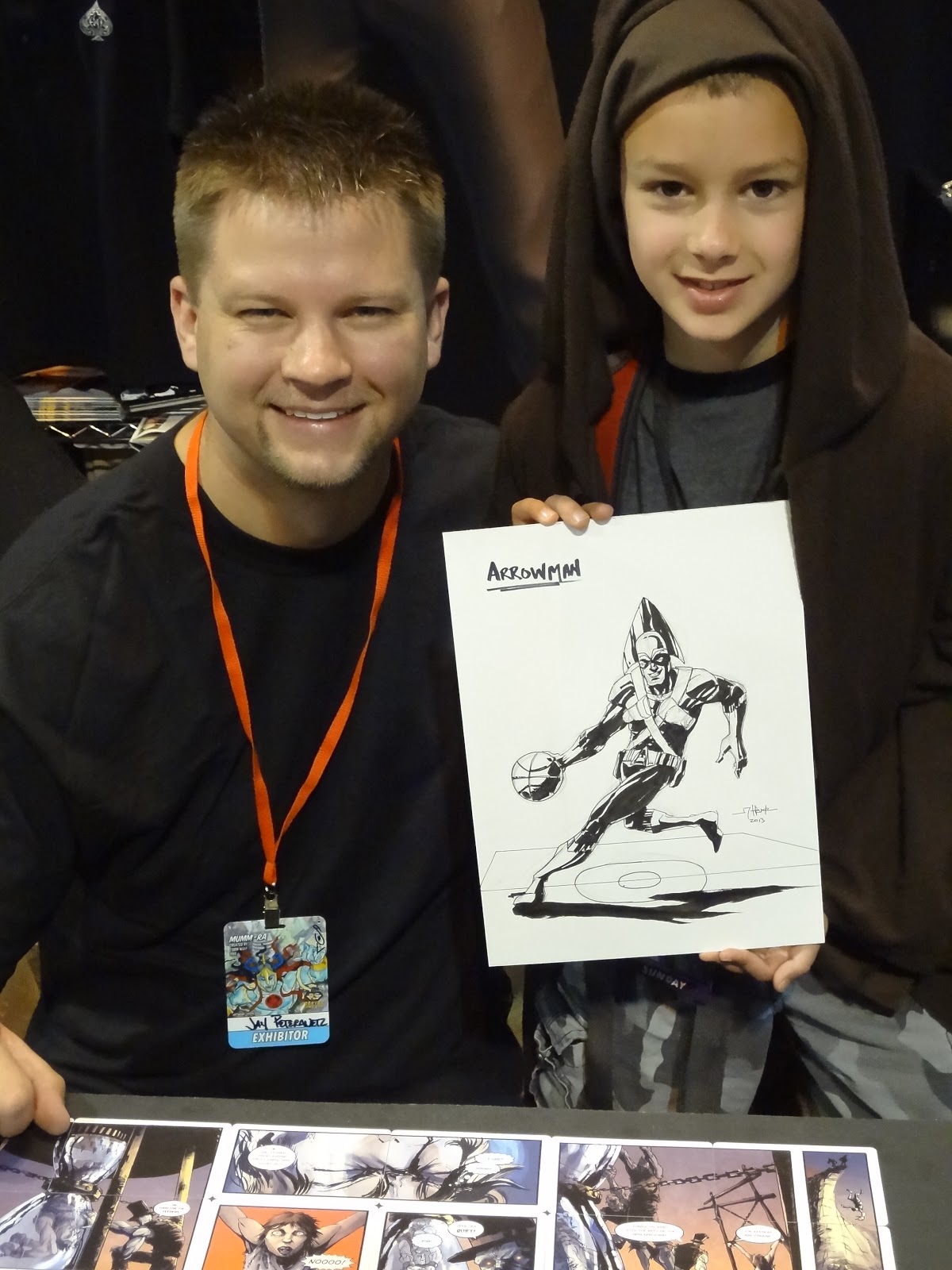
I spent last week at the Rocky Mountain Conference on Comics and Graphic Novels and the subsequent Denver Comic Con. It was an enormously fun and profitable time. I got to spend the first two days learning from some very smart people working on comics across the spectrum, and then I got to spend a couple days geeking out (not like I don't do that anyway) and visiting with friends like Mike Lafferty and my sister Suzanne, her husband Chris, and my nephew Jake. Long live Arrowman!

I think it was on Thursday when Hannah Menzies and Doug Singsen began talking about religion and superheroes, and Doug graciously suggested I might have something to contribute on this topic. Not that anyone has ever been able to get me to shut up in the first place, but it was kind of him to invite me.

The first thing we should acknowledge on this topic is that no one is better qualified to opine on it than A. David Lewis, who has been writing comics on, and studying superheroes with, religious themes for years. And A. Dave, as he is known in these here parts, besides having a Ph.D. in Religion and Literature and being an accomplished scholar, blogger, and comics creator, has a skill at self-marketing which I am openly envious of, so the fact that I am plugging him here is just demonstrating how well he has cornered this particular field.

There are also several books on the topic, most of which I have not gotten around to reading yet. One that I have read is The Gospel According to Superheroes, but I don't especially recommend it, because while some of its arguments are interesting, it typifies the biggest problem with books of the "Comics And ..." variety, and that is that while the "And..." part is always well researched and documented, backed up by theory and criticism, the "Comics" part is not. The only book or article about comics referenced in The Gospel According to Superheroes is McCloud's Understanding Comics, and as those of us in the field know, that is the beginning of the conversation, not the end. I have, however, heard rave reviews of Do The Gods Wear Capes, including from Kent Worcester, who is no slouch in this department, and I look forward to reading it. We should also acknowledge Reynolds' Superheroes: A Modern Mythology, which I think most of us can agree was published ahead of its time, and which has stood up surprisingly well over the years. It's also very approachable by students, and that is no small thing.

With the necessary preamble out of the way, we can get back to the question, which I believe goes something like: "So: Superheroes, Religion; Discuss."

It seems to me that religion intersects with superheroes in the same way that most things intersect with superheroes, and that is in the world of metaphor and allegory. Some people -- like Tom the Dancing Bug and his God-Man strip -- have had a lot of fun suggesting that superheroes are filling the role of God or gods to us these day, but I think this is a bit of a deceptive trap. The superhero is an American invention and Americans do not pray to or worship Superman or Captain America. Mentally healthy individuals do not believe Superman or Captain America exist in the same way they might believe God exists, even when they do decorate their bodies with indelible Superman symbols.

But what superheroes are really good at is telling stories in shorthand; using symbols we all recognize in order to tell a powerful and resonating story with great economy in six, or eight, or twenty-two pages. So, for example, when we see Superman's father send his only son to Earth, we get it. When that infant from one world is rescued by parents of another world, where he is raised in ignorance of his true heritage, only for it to be revealed later in a moment that forces him to choose which of his pasts he is going to embrace, we get it. When Superman sacrifices himself for others and then falls back down to Earth with his arms extended, we get it. And the reason we get these stories, the reason we feel them in our gut, is because they are using the vocabulary of religion as a kind of shorthand for some very complicated ideas. When Clark finds out that he was born on another planet, that the parents that raised him all his life are not the ones who gave him life, and he is forced to choose, a good writer can tap into Moses's personal dilemma and can even play with it. So when, in some stories, Clark embraces his Kryptonian heritage, he's more like Moses, who embraces the fact that he is a Jew and becomes a champion of the Jewish people. But when Clark says no, no, I might be biologically Kryptonian, but in my head and in my heart I'm an American, it's almost like a reverse-Moses. Superman becomes Bizarro-Moses, the Moses who chooses to be Egyptian after all.

Let's take the New Gods for example. If ever there were superhero characters who seem to be about religion, it would be the New Gods. I mean, it's right there in the title. And yet, Highfather and his kind are never worshipped. When worship happens in the New Gods, it is always directed towards Darkseid and is always portrayed as a deeply awful and compromising thing. Orion, Mr. Miracle, Lightray, Metron and the other characters are deeply symbolic, but they are no more gods than Paul Bunyan is a god. What they do is allow us to talk about God in a new, fresh, way. When it is revealed that Highfather does not call the shots on the planet of New Genesis, but in fact answers to a parliament of children, we are reminded that the meek shall inherit the Earth, that the powerful should always answer to the needs of the lowest among us. When Mr. Miracle escapes from yet another enemy without ever throwing a punch, when he is "surely killed" only to rise again in a daily miracle, we are reminded that peace and non-violence are the heart of Christian teachings. The New Gods are, in fact, not the ultimate power in their own setting; there is a disembodied hand which writes on a wall, and that hand belongs to the Uni-Friend, a symbol so obvious that Kirby didn't have to say anything more about it. Ultimately, the New Gods aren't gods at all. They're people of faith, who revere something more powerful than they, something without form but all-loving and all-knowing, something they struggle to understand and live up to. They're us, basically.

Faith is an important part of American culture and I don't see that changing any time soon. It seems to be perfectly appropriate then for superhero comics to use the symbols and language of faith in their stories, because these are symbols and language that most Americans recognize. Which means those scenes work, and will continue to work, for a long time. But in superhero comics, faith has generally been a secondary topic. When it is directly addressed, such as in Frank Miller's Daredevil or Claremont's Nightcrawler stories in X-Men, it was usually an eye-opener, because these sorts of stories were so unusual. Stories like Starlin's Infinity Crusade, Denny O'Neill's Question, or Starlin and O'Neill's Batman story The Cult, were considered "edgy" at the time, because they used the language of Christian religion in morally ambiguous ways.

But filmmakers have been much less hesitant to use religion in superhero films. Personally, I blame the crucifixion pose for this. That damn pose is easy to do, common in films from Superman to Alien: Resurrection, and directors have gone to it so often and so repetitively that I'm always surprised to see a falling action star who does not adopt it. And because these films have made a huge commercial impact on the superhero business, the frequency with which Christian religious symbols have been used in films has bled over into superhero comics, so that now Nightcrawler has, in the comics, become a priest.

I'll leave with one last observation, and that is that some of the best writers working in superhero comics have used their names and reputations to tell stories which give intensely personal stories about faith. In this bucket, I place Morrison's All-Star Superman as well as his non-superhero book The Invisibles, and also Alan Moore's Promethea. All-Star and Promethea are not books which could have been published when their creators were young. Morrison and Moore had to attain a certain invulnerability in the marketplace first. In All-Star, Luthor is converted to good when he sees the face of God. He acquires Superman's powers and, in this state, physically perceives a single intelligence which organizes the universe. We don't see it. But Luthor does and, by necessity then, Superman has. And this explains much about Superman's faith that "there's always a way," in his unshakeable confidence in the innate goodness of all human beings, because he knows there's a God, and God would not allow the world to be a fucked up and unjust disaster. Superman is not at all a being of faith, because he doesn't need faith. He can see God!

And I could unpack Promethea here too, but honestly, you won't read it anyway. Which is a real shame, because it's an amazing book. But when the protagonist goes on a metaphysical tour of the universe in which the Kaballah is represented by subway stations (that's just one issue) and she meets Jesus, God, and the Devil (that's another issue), and has Solomon decide whether or not she gets to keep her powers or cut them in half (a different issue), well, let's just say it's a book about religion and leave it at that.

Wednesday, May 22, 2013

Journals, Comics-Friendly


Orion, a long time regular on the Comics Scholars Discussion List, began a thread that ended very profitably, with a list of journals focused on or open to comics scholarship. My thanks to Mike Rhode, who helped me locate this list. 

ImageText
- peer reviewed
- open access (online)
- submissions required to be "grounded in theory"

International Journal of Comic Art
- not peer reviewed 
- subscription (print)
- ToC available online
- very international

European Comic Art
- peer reviewed
- subscription (print)
- ToC available online
- English-language papers but European content

The Comics Journal
- not peer reviewed
- subscription (print)
- non-academic but fan-scholarly (?)

Journal of Graphic Novels and Comics
- peer reviewed
- subscription (print)

Journal of Popular Culture
- peer reviewed
- subscription (print)

Studies in Comics
- peer reviewed
- subscription (print)
- interested in comics as "unique art form"

Image [&] Narrative
- peer reviewed
- subscription (print)
- in English and en Française
- "visual narratology and word and image studies in the broadest sense of the term"

SANE Journal
- peer reviewed
- subscription
- education oriented

Studies in Graphic Narratives
- peer reviewed
- subscription (print)
- early history of comics/sequential art

Mechademia
- peer reviewed
- subscription (print)
- ToC and some content on Amazon
- manga, animation, and Japanese visual culture

Participations
Animation
Adaptations
Games and Culture
Game Studies

Belphégor 
- peer reviewed
- online
- French, English, German, Italian, Portuguese, Spanish
- "dedicated to the study of popular literature and media culture"

Comicalités
- peer-reviewed
- online
- en Française
- "entend interroger la spécificité ainsi que l'évolution des modes d’expression, de production et de réception de la bande dessinée, de l'illustration, de la caricature, du dessin animé"

Deutsche Comicforschung
- not peer reviewed
- print
- ToC only online
- im Deutsche
- specialized in early German comics

Mechademia
- peer reviewed 
- print

Reddition: 
- not peer reviewed 
- print 
- im Deutsche
- fan-oriented

Scandinavian Journal of Comic Art
- peer reviewed
- online 

Tebeosfera
- not peer reviewed
- online

The Comics Grid
- peer reviewed
- online/print

Revista latinoamericana de estudios sobre la historieta (since 2001)
Historietas
- peer-reveiwed
- print

L'Indispensable
- not peer reviewed
- print

Transformative Works and Cultures
"TWC publishes articles about transformative works, broadly conceived; articles about media studies; and articles about the fan community.We invite papers in all areas, including fan fiction, fan vids, film, TV, anime, comic books, fan community, video games, and machinima. We encourage a variety of critical approaches, including feminism, gender studies, queer theory, postcolonial theory, audience theory, reader-response theory, literary criticism, film studies, and posthumanism. We also encourage authors to consider writing personal essays integrated with scholarship; hyperlinked articles; or other forms that test the limits of the genre of academic writing."
Textimage
- peer-reviewed
- en Français

du9
- not peer reviewed
- en Français

Nona Arte: Revista Brasileira de Pesquisas em Histórias em Quadrinhos
- peer reviewed
- Portuguese 

The Scandinavian Journal of Comic Art 
- peer reviewed
- open access online: http://sjoca.com
- English language
- focus on Nordic countries, but not limited to them

Wednesday, May 1, 2013

Kill Shakespeare

My latest article is out.

It's at ImageTexT, a wonderful journal published by the University of Florida. I remember when this journal started, and I have wanted to be published in it since that day, so this is kind of a six-year career milestone for me. I'm deeply indebted to Katherine Shaeffer and Richard Burt for including me.

The issue is organized around the special topic of Shakespeare and Visual Rhetoric. Shakespeare's connection to comics has been a special interest of mine for a long while now; I briefly even tried to organize an essay collection on the topic. I eventually realized that perhaps I ought to finish my dissertation before doing any essay collections, and the work I was going to put in that collection wound up as the fourth chapter of my diss.

For this issue, I focused on "Kill Shakespeare," a 12-issue series published in 2010-2011. It's a very interesting work which earned both condemnation and praise when it was published but which, in my opinion, has not gotten credit for the very interesting ways it goes about defending its own existence, the nature of meta-text, and revisionism in general. I had a lot of fun writing it and I'm indebted to the original authors and artists who cooperated with me by sending me original scripts to a few issues I wanted to examine in detail.

You can read the entire issue on Shakespeare and Visual Rhetoric here.

And my article is here: "These are not our Father's Words: Kill Shakespeare's Defense of the Meta-Text"

Tuesday, April 23, 2013

Thoughts on PCA

I posted this today to the new Facebook page for the Comic and Comic Arts Area of the Popular Culture Association. The community has come to mean a lot to me over the years.

What makes the Comics Area at PCA different?

I'm delighted to admit that there are many academic conferences which focus on or include comics research. So, what makes the Comics and Comic Art area of PCA different? If conferences and communities have a specific character, what's ours? I'm obliged to note that these observations are personal and unofficial. They are offered in a spirit of welcome and cooperation with visitors to our area and those interested in submitting a paper.

#1: First Contact

PCA is often the first point of contact for an aspiring or young scholar, his or her first introduction to the larger community of comics scholars. The biggest reason for this is the fact that paper proposals are not, as a general rule, rejected by Area Chairs. You could count the number of rejected papers in our area on one hand, and I think you'd still have fingers left over. It is a perfectly fair observation to say that PCA is not selective. While that has all sorts of negative consequences in academia, it also has one strength: everyone feels welcome. We routinely have grad students, undergrads, and even the rare high school student presenting work at PCA. When those new scholars arrive at the conference, it is usually their first conference. When those scholars meet other comics critics, it is often for the first time. Many in our current community first found us when they were at PCA presenting in another area. When we are lucky, we steal these presenters for ourselves.

As a result of all this, I think you'll find an open mind at PCA, a supportive community, and a willingness to answer questions and make connections.

#2: Time Served

Tom Inge, an active member of our area, was present at the first meeting of the Popular Culture Association back in 1971. John Lent, editor of the International Journal of Comic Art and another of the founders of our area, joined a few years later. Amy Nyberg served ten years as Area Chair. Nicole Freim served another ten. Many students and professors come to the field of comics with the presumption that it is a "new" or "emerging" field with a dearth of scholarship, canon, or critical tools, but the facts suggest otherwise; you would be hard pressed to find a community of comics critics and scholars with a longer history.

Because of the area's long lifespan, you can find a lot of institutional memory. At the same time, if your approach to comics is based on the idea that "not a lot of people are doing this," or "comics haven't yet reached credibility as a field," you are going to get some resistance and push-back. For many of these men and women, comics is not a secondary or tertiary field, the equivalent of an after-dinner mint. It is a primary field and has been for decades.

#3: IJOCA

The area has always had a special relationship to the International Journal of Comic Art. John Lent, editor of that journal, attends every year and uses the conference as a way to screen potential articles and submissions. There was a time when IJOCA was the only academic journal in English that was devoted to comics; we are all glad that this is no longer the case, but PCA played a role in helping to establish IJOCA, getting it subscriptions and a truly intimidating page count. In this day of Powerpoint presentations and increasingly crowded panels, it is always tempting to forgo actually writing an essay which, in all fairness, you wouldn't have time to read anyway. But consider prepping a complete version for potential submission, because even if IJOCA does not use it, there are other things you can do with it.

#4: Awards

We give two awards every year. The first, and by far the oldest, is the Inge Award for outstanding comics scholarship. It is given to the best of the submitted papers from that year's conference. Three judges are recruited at the Area Meeting. Amy Nyberg provides a plaque and modest honorarium out of her own pocket. Our second, and more recent, award, is the John Lent Award, which is given to the best paper submitted by a student. Again, not everyone submits papers to these competitions. Indeed, most presenters do not. Consider prepping at least a draft version of an actual paper; Amy allows a couple of weeks after the conference for authors to revise and complete essays which may still be in draft form at the time of the conference.

Many of these essays have gone on to see publication in various journals over the years.

#5: University of Mississippi Press

For many years the area had a close relationship with UMP, which was an early leader in the publication of comics-related research. This relationship began with Seetha Srinivasan, who was Director of the press and served there for 29 years. After her retirement in 2008, the comics line she pioneered was picked up by editor Walter Biggins, who has also just announced a move. This leaves the comics line at UMP in some amount of doubt.

#6: Area Dinner

I'm sure every conference has regular social events; let me tell you about ours. The area dinner is usually planned for a Thursday or Friday evening, depending on the schedule. It is usually quite large, with about thirty attendees. There's no official budget for this; we all pay our own share of the check. And because the area is so large, the dinner can frustrate some attendees, who end up speaking only to the few people seated near them. But this is a great opportunity to make some new and interesting friends, and you never know what will come out of it.

#7: Korvac

Finally, I would be remiss if I did not mention the Institute for Korvac Studies, our sister organization and the source for the legendary Korvie Award. The Institute is a mock-academy panel we have held almost every year for about the last decade. On that panel, we make fun of ourselves and what we do. The traditional Korvac paper picks a minor, obscure, or absurd character (such as the Man-God Korvac) and explains how this character is actually the most important topic in our field, in academia at large, or indeed in all the time-space continuum. Another common tactic is to do an absolutely batshit crazy reading of any number of batshit crazy story arcs produced by the superhero comics industry over the last 75 years. Any topic is welcome, as long as it is not serious. Be aware that the Institute for Korvac Studies appears in the PCA program and the titles of our papers are often so over-saturated with self-mocking jargon that they sometimes get taken for legitimate papers by those not in on the joke. Make of that what you will.

I've been attending PCA for about fifteen years. It's a wonderful community of supportive, brilliant, and energizing people who are both scholars and, I am lucky to say, my friends. I hope you find a home here, as I have.

Dr. Jason Tondro
Assistant Professor of English
College of Coastal Georgia

Monday, February 4, 2013

Oxford Magica: Introduction

It is the year 1290 in the reign of Edward Longshanks, and Gifted students from throughout the British Isles and western Europe come to Oxford to learn the Art from magi of the Order of Hermes. You are one of these pupils.

Oxford is not a single school, but a collection of Colleges, each financed and run by a single Hermetic House. Students at any of these Colleges register with a master who guides their education; they attend mandatory lectures, which might be given by any of the masters present at Oxford, not just the student's College. Roger Bacon, former Chancellor of the University and member of House Bonisagus, is now a professor Emeritus, living in Oxford and only occasionally appearing in public.

Most students enter between the ages of 14 and 16; the best graduate as magi of the Order ten years later (it is very common for students to be held back for one or two years). Before arriving at Oxford, these students have spent years learning Latin and the liberal arts, often at parish schools. But parish schools are not rigorous enough for aspiring Oxfordians; cathedral schools at Canterbury (in the south) and York (in the north) train students in advanced Latin and the liberal arts as well as natural philosophy. Wealthier students avail themselves of private tutors instead. The Gift has made this early education a trying experience, as teachers uniformly consider their students lazy and shiftless cheaters.

The Order's interest in Oxford dates back to the mid-12th century, but the turning point was in 1209. In that year, a murder on campus and the legal controversy which followed sent most of the masters and students to Cambridge. By the time they tried to return five years later, magi of the Order had taken over. When the University re-organized itself under a Chancellor appointed by the bishop, it was as a place of learning devoted primarily to the responsible and ethical use of magic.

Every student at Oxford identifies with his College and House. The Colleges currently established at Oxford include, in order of founding:

  • Baliol College is home to House Trianoma, aspiring politicians and diplomats. It was founded in 1261 by students of Michael Scot.

  • Merton College is run by House Bonisagus, and is known for its scholars and theorists. Founded in 1264, Merton is in the process of building grand new facilities.

  • St. Edmund Hall was founded in 1278 by the first master of arts at Oxford, who unexpectedly became a practitioner of the Faerie magic of House Merinita.

  • University College is Merton's great rival. It was first founded informally in 1249 but was taken over by the trouble-makers of House Tytalus in 1280.

  • Hart Hall, founded 1282, is for students of Druidic and nature magic, including House Diedne. Many British folk traditions (Columbae and Corrguineach) have allied to Diedne and are also housed here.

  • The wild Saxons of the House of Odin live in Burnell's Inn, a student residence known for its raucous parties. Some Saxon and pagan traditions (Tempestaria and malice writers) have allied themselves to Odin and their students reside here.

  • Finally, the monastic orders maintain two colleges for Holy Magicians, segregated by gender. Blackfriars, originally founded by the Dominicans in 1221, is for boys, while Godstow, which dates to the 12th century and was founded by Benedictines, is for girls.

  • In the years to come, it is very likely additional Colleges will form, sponsored by additional Houses. Historically, the next College to form was Exeter in 1314.

More on the Order: The Order of Hermes is made up of many Houses, some large, some quite small, generally distinguished by a particular style or tradition of magic. Most of the lineages traditionally considered to be part of House Ex Miscellanea or minor Mystery Cults are, in Oxford Magica, distinct "minor" Houses. These may be allied with a more famous House; for example, the British folk traditions are mostly allied with Diedne, the Order of Odin, or Merinita. Learned magicians are welcomed into Bonisagus. Some major Houses, such as Flambeau, Tremere, and Jerbiton, are stronger in Europe where they sponsor other universities and have not yet organized at Oxford. House Mercere and Guernicus do not exist as Houses; "Redcap" and "Quaesitor" are offices held by mundane messengers and investigative magi, respectively. If you have additional questions about the Order and its history (Schism War, Tytalus Corruption, etc.) the answer is probably "I haven't decided. What do you think would make a good story for your character?"

Character Creation Notes:


  • The base starting age for characters in this Saga is (17 - Intelligence). Characters younger than 14 will have characteristic modifiers for age; see Apprentices. Ignore these modifiers when determining the age your student is admitted to Oxford.

  • To be accepted into Oxford, characters must have: Latin 4, Artes Liberales 1 and Scribe 1. Philosophiae 1 is likely, but not required.

  • Characters will need a virtue to access these academic abilities, such as Educated (for parish and cathedral schools) or Privileged Upbringing (for private tutors).

  • Early education might have been provided by a rural Parish School (maximum Latin or Artes Liberales of 2) or urban one (maximum of 3 in Latin, Artes Liberales, or Theology).

  • Additional education probably came from a cathedral school, permitting training in Latin, Artes Liberales, Philosophiae, Theology and Canon Law to as high as 5. Canterbury is the cathedral school for most Englishmen, Welsh and Cornish; York is in the north and is more accessible to Scots and Irish.

  • Everyone starts with the Free Social Status Virtue: Simple Student (Art & Academy).

  • Child Virtues and Flaws (see Apprentices) are allowed. In Apprentices, the rule is that these virtues all go away by age 15, but we will keep them in play as late as age 21. You can exchange them for new, permanent Virtues and Flaws during play or over Summer vacation.

  • Inherited Virtues and Flaws (see Apprentices) allow players to plan for Virtues and Flaws which have not yet appeared, but which will during the course of play. Use this for Hermetic Virtues and Flaws you want your character to have, but which have not yet appeared. For example, if you want your character to have a Hermetic Flaw like Incompatible Arts, this is written down as Inherited Flaw: Incompatible Arts (-1). The Flaw is unknown to your character until it manifests.

Other House Rules:


  • The Autumn and Spring seasons are taken up by instruction; each lasts about 4 months. The Winter season is represented in the game by a break between semesters lasting about six weeks, and two and a half months are granted for the Summer season; these two seasons are "free," with no requirements on students.

  • We will advance one season every meeting, possibly skipping Summer or Winter break and occasionally spending a second session on Fall or Spring. Players are not expected to attend every session and new players are welcome to make a new student and join a session on short notice.

  • In the first year, students have their Arts opened and learn the basics of Magic Theory. In subsequent semesters, they have more choice over which lectures they use for advancement, with usually seven options available (one teacher at each House).

  • Teachers can teach Arts to multiple students at once, exactly like other Abilities.

  • Aegis of the Hearth mitigates the social handicap of the Gift within the town of Oxford. The Blatant Gift still inflicts a social penalty equivalent to the normal effects of the Gift, and of course leaving the Aegis restores the Gift's effects.

  • Turbulences (see Apprentices) are spontaneous uncontrolled magical effects triggered by emotional or magical stress. They can even be triggered intentionally by a young person. By the time a student comes to Oxford, he has certainly experienced at least one episode of Turbulence, and probably many more. In Apprentices, Turbulences are mostly over by age 14, but we will keep them in play as late as age 21.

  • Students will receive 1 free experience point every season to put towards a cantation of their choice. See Apprentices for a list of cantations; they are minor spells of level 5 or less.

  • Oxford has a lot of magi and apprentices in a small urban space; vis is in very short supply and this is a "Low Vis" Saga. Books and teachers, however, are plentiful.

  • In the event we play long enough for characters to graduate, those characters retire from active play and become supporting characters in the Saga. They may become masters, teaching at Oxford.

Sunday, February 3, 2013

Ethereal Tribunal: Character and Covenant Creation

Characters and Covenants in Etheria have some particular problems and priorities. Notes are collected here, first for character creation (magi, companions, and in general) and then for covenants. A sample covenant -- the Seven Sisters on the Isle of Venus -- is presented.

Note to Storytellers: I am adopting the Seven Sisters covenant as the focus of my personal efforts when it comes to detailing Etheria. If you would like to claim one of the other Isles, and the Covenant which dwells there, please do! Post your work in the Ethereal Tribunal community on Google+ and we can advance the Tribunal's story together.

Magi
Magical Botches: The high aura throughout Etheria makes botching especially dangerous for Ethereal magi. Spell Mastery and Virtues which minimize botching (Flawless Caster, Mastered Spells, Cautious Sorcerer) are especially helpful here. Flaws which make botching more likely are more dangerous.

  • Cyclic Magic: This Virtue and Flaw is especially appropriate to maga on the Isle of the Moon.

  • Hermetic Astrology (Mysteries, Revised Edition): Some of the magi who have come to Etheria have been initiated into the Magoi of the Star. Indeed, it is said one of the Hierophants is here, but no one can agree who that is.

  • Major Magical Focus (Planet): Each of the seven planets counts as a major magical focus; for the range of effects governed by each planet see Mysteries, Revised Edition.

  • Mercurian Magic: This is especially appropriate for magi dwelling on the Isle of Mercury, who include members of the Neo-Mercurian mystery cult.

  • Planetary Magic (Mysteries, Revised Edition) is especially appropriate for magi in Etheria. Magi who use it calculate their horoscopes using the positions of the seven islands relative to each other and the sphere of the fixed stars.

  • Susceptible to (Planets) (New Minor Hermetic Flaw): Pick two planets. When within any auras aligned to these planets, the aura strength subtracts from your casting total, instead of adding.

  • Susceptible to (Realm): There are no Faerie, Divine, or Infernal auras in Etheria, so these flaws are not worth points. A magus might have them, and indeed having such a flaw would be a good reason to move to Etheria, but since the flaw will not impact the character, its not worth points!


Companions


Most Companions should have a Supernatural Virtue aligned to the Magic Realm. This allows them to avoid Warping, which will otherwise affect all characters with 1 Warping Point every year.

Landed Noble and Temporal Influence: The mundane nobility has no presence in Etheria. Your character might be a noble, but his land is back in the mundane world. Consider Knight, Wealthy, or Heir instead.

General


These notes are for all characters in Etheria.

  • Animal Ken, Inoffensive to Animals: There are no normal animals in Etheria, but there are limited numbers of Beasts of Virtue and, as characters from the mundane world continue to travel there, it is possible that small populations of ordinary animals may migrate, be brought, and thrive.

  • Faerie Friend, Ghostly Warder, Guardian Angel, Plagued by Supernatural Entity: Supernatural beings of the Faerie, Infernal, and Divine Realms are not native to Etheria. You probably brought your supernatural companion with you.

  • Lycanthrope (Minor): In Etheria, Lycanthropes are in animal form whenever they are on the Isle of the Moon, and in human form at all other times. Since this essentially bars you from traveling to that location and could potentially be used against you by an enemy, but otherwise is irrelevant to your life, this Flaw is only Minor.

  • Mistaken Identity: The community of the Tribunal is still quite small. There's no room for two individuals who are that near but never meet. This Flaw is not allowed.

  • Shapeshifter and Skinchanger: Magi and companions with these virtues are mostly found on the Isle of the Moon.

  • Supernatural Nuisance: When a character takes this Flaw in Etheria, it is always aligned to Magic creatures.

  • Venus's Blessing and Curse of Venus: Especially appropriate for maga on the Isle of Venus.

  • Ways of the (Land): The terrain of Etheria is highly symbolic and variable by Isle. This virtue should be specialized to one of the seven Islands or, alternately, the Twilight Sea. For example: "Ways of Jupiter".


Covenants


There are no less than four, and possibly as many as seven, covenants in the Tribunal. All are in Spring and the oldest was founded in 1207. There is never more than one representative from a single House at any given covenant.

  • Isle of the Moon: Cyclic Magic (both positive and negative) is especially common in this covenant. Some of the magi and companions are Shapeshifters (with the Merit, not members of House Bjornaer). The Isle of the Moon is the only known source of Muto vis in Etheria.

  • Isle of Mercury: The covenant here is dominated by magi who draw their lineage from the Cult of Mercury and who specialize in ritual magic. It is also the home for the Tribunal's redcaps.

  • Isle of Venus: The Isle is home to Seven Sisters, a covenant made up entirely of maga.

  • Isle of Mars: Several Hoplites, seeking to build a stronghold for the Order, have gathered on the Isle of Mars to form a covenant.


Other Covenants may exist, but details are not yet known.

Using the Covenant rules, most of the Etheria covenants are transitioning from "low" to "medium" power. Covenants have 25 build points + 25 more points for every year since they were established, so even the oldest will have only around 400 points. Lab texts and enchanted items should be level 30 or less. The default aura in Etheria is 6; no build points or virtues need to be taken for this aura. Auras can be raised as high as 9. It is presumed that one exit from the regio exists either within the Covenant or conveniently nearby, on the island. For additional exits, take the Mystical Portal Site Boon. There are a Boon and a Hook which apply to all covenants in the Tribunal; they do not need to be selected, and are received for "Free".

Fantastic Environment (Major Site Boon): Every covenant in Etheria takes this Boon. While it does not require special magic just to survive in the regio, it is isolated enough, and requires magic both to be reached and for long-term support. This Boon supersedes all other Boons and Hooks that emphasize isolation, such as Secluded or Autocephalous.

Tribunal Border (Minor External Relations Hook): Etheria is newly discovered and, when it becomes common knowledge in the Order, it will become the target for Hermetic politics. Powerful tribunals will seek to assimilate it to preserve their own power; weak Tribunals may encourage it as a way to weaken greater powers.

Prohibited Boons and Hooks: Etheria's isolated location, its lack of native inhabitants and mundane power structures (nobility, the church), and its nature as a Magic Regio prohibit several boons and hooks. Others are already covered by Fantastic Environment.
  • Site: Corrupt Area, Faerie Aura, Missing Aura, Seclusion, Regio, Road, Urban, Weak Aura

  • Fortifications: Writ of Crenelation

  • Residents: Indigenes, Tame Nobleman

  • External Relations: Center of Excellence, Centralized Kingdom, Church Territories, House Covenant, Mundane Politics, Undemocratic Tribunal, Ungoverned, War Zone

  • Surroundings: City, Ford, Legendary Site, Monastery, Pilgrimage Site, Roman Ruins, Seat of Power, Ungarrisoned Castle


Miscellaneous Boon and Hook Notes:
  • Island: while all the covenants are on islands, these are much larger than the Free Choice Island describes, so this is probably not appropriate for covenants.

  • Fortifications: Almost all the architecture in Etheria was constructed by Hermetic magic, as there has not been time or personnel to build in the traditional manner, and magic is easy anyway, and unobserved by mundanes.

  • Resources: The most common source of income for Ethereal Covenants is the patronage of a wealthy Autumn covenant, or even a House or Tribunal. However, there is a small economy and perhaps a thousand people living in the Tribunal, so other sources are possible. Covenants who sell their wares in the mundane world do so through a factor, which should probably be purchased with Build Points as a specialist.

  • Mutable and Highly Mutable are most appropriate for the Isle of the Moon.

  • Mercer House is reserved for the Isle of Mercury.

  • Felicitous Tribunal: The politics of the tribunal are as yet too uncertain to know if this Boon applies.


The Covenant of Seven Sisters


The oldest of the Ethereal covenants is nonetheless young by any other standard, founded in 1206 by Anactoria filia Philomena of Bonisagus and a trio of other maga, including Jerbiton, Tremere, and the first Guernicus in Etheria. Over the years that followed, three more maga were welcomed into the Covenant from Flambeau, Verditius, and Miscellanea, putting it at maximum size.

The charter of Seven Sisters requires that only women can become members and all apprentices must be female. This rule does not extend, however, to Companions or covenfolk. The Covenant operates as a school for apprentices and other scholars, and welcomes male students from elsewhere in Etheria or Mythic Europe, though such boys are always outnumbered. The presence of a senior Guernicus at the covenant is considered an asset, ensuring that apprentices and other students are brought up with an appreciation of the Hermetic Code. All of the maga save for Anactoria have apprentices, and with the addition of students and visitors from other Covenants, the Isle of Venus is a busy place.

Physically, the Covenant boasts a central school building in the Corinthian style, with slender and elegant columns widely spaced, creating an airy and open environment. Stone houses surrounding the academy serve as laboratories and sanctum for the seven maga, also housing their apprentices, shield grogs and personal servants. A beautiful garden decorated with statues of Venus, Aeneas, Paris, Helen, Julius Caesar and others was constructed by the Covenant's Verditius maga as a Great Work, and is invested with Imaginem magic. Other buildings include a reception hall, guest chambers, and a temple to Venus which serves as the home for the covenant's financially lucrative prostitution services. Most of its money comes from Valnastium, however. For while Etheria is far enough from the nobility and the church that House Jerbiton is unlikely to move there in force, the Isle of Venus and its dedication to beauty parallels the House's interest, and Seven Sisters is their primary means to monitor and influence the activity of this new, strange Tribunal.

The covenant is near the shore, and a small dock houses a magic boat enchanted to safely sail the Twilight Sea. A modest vineyard produces an excellent wine for the Tribunal and is also sold in Europe. Roses and myrtle grow on the isle, along with a single herd of magic cattle. A small cemetery is dedicated to Venus Libitina and copper is plentiful on the Isle, mined by magic and used for mirrors and other enchanted devices.

The Covenant is 16 years old with 425 build points and is limited to effects of level 30 or lower.

  • Vivid Environment (+1 Minor Site Boon)

  • Edifice: School Building (+1 Fortification Boon)

  • Important Buildings: Great Hall (+1 Fortification Boon)

  • Secondary Income: Prostitution (+1 Resources Boon)

  • Wealth: Charity (+1 Resources Boon)

  • Literate Covenfolk (+1 Residents Boon)

  • Strong Community (+1 Residents Boon)

  • Book (+1 Boon, Great Work Garden of Beauty, Imaginem Summa, Level 20, Quality 15)

  • Hermetic Services (-3 Major External Relations Hook)

  • Outbuildings (-1 Fortification Hook)

  • Resident Nuisance (-1, Nymphs, Minor Site Hook)

  • Vis Salary (-1 Minor Hook)

  • Gender Imbalance (-1 Minor Residents Hook)

  • Suffrage (-1 Minor Residents Hook)


Build Points: 425
Aura: 6
Aegis: level 30
Laboratories: 7
Library (196 Build Points): Most of the Covenants in Etheria have very poor libraries and Seven Sisters is no exception. Their emphasis is on teaching, so they have less need for traditional books on the Arts, and make do with a large collection of lab texts (mostly copied from the seven maga themselves) which students can use to learn spells (330 spell levels, 66 Build Points). They do have a small collection of thirteen tractati on various Arts (average quality 10, 130 Build Points). Increasing the library is the Covenant's top priority right now.
Vis (30 pawns/year, 75 stock, 165 build points): The Isle of Venus is Etheria's primary source of Imaginem vis, produced in a small copper mine on the island (15 pawns/year). It has a source of Aquam vis from foam collected off waves as the roll in from the Twilight Sea (5/year), some Auram vis from Spring breezes (5/year), and a small source of Creo vis thanks to its association with fertility (5/year), but at least one season must be spent every year extracting Vim vis to fuel the Covenant's Aegis of the Hearth. This duty is shared amongst all seven maga. The Covenant has emergency stocks of 75 pawns, divided evenly among all the Arts.
Grogs (35 Build Points): The Covenant maintains a very small body of soldiers, essentially shield grogs acting as an honor guard, commanded by one of the maga in her role as Venus Victrix. There is a skilled Bookbinder (6), Illuminator (6), and Scribe (6, also trained in Magic Theory). Their boat is maintained by an old man who also acts as pilot and navigator (Profession 6), and a vintner has been brought to supervise the winery (Profession 6). Many of the female servants act as prostitutes for visitors; they have a female overseer who is a priestess of Aphrodite (Folk Ken 5).
Facilities: In addition to living quarters and labs for seven magi, there are living quarters for seven apprentices, a few class rooms of varying size and purpose, servant quarters, guest rooms for students from other covenants, a reception hall for visitors, and a barracks for the honor guard. A small dock houses the Covenant's magical boat which sails the Twilight Sea. The Covenant is decorated with beautiful statues depicting, among others, Aeneas, Paris, Julius Caesar, and Venus herself. Constructed in a Corinthian style, the buildings are supported by slender, elegant, widely-spaced columns decorated with leaves, creating a large airy space. A small field of grapes is used to produce a humble everyday wine. Roses and myrtle grow also grow on the Isle as well. There is a small cemetery on the isle dedicated to Venus Libitina.
Enchanted Items (24 Build Points): The Covenant keeps a Twilight Boat and all seven of the shield grogs bear Copper Shields of Brilliance.
Money (5 Build Points): 50 mythic pounds at start of play

Twilight Boat
This is a boat capable of holding about a dozen people. It is enchanted with two effects. The first is a constant Rego Herbam effect which keeps the boat from tipping over. The second, also Rego Herbam, propels the boat, steered by whoever grips its tiller.

  • Spell Against Capsizing (ReHe 14). Base 3, Personal, Individual, +2 Sun, +1 Size, +1 level 2 uses per day, +3 levels environmental trigger (sunrise/sunset). Constant effect.

  • To Sail Without Wind (ReHe 10). Base 4, Personal, Individual, +1 Size, +1 Concentration (+5 levels, provided by the enchantment).


Copper Shield of Brilliance
Once per day, the shield emanates a blindingly bright light. All who see it are at risk for temporary blindness, exactly as if Flash of the Scarlet Flames had been cast upon them. This light is actually brighter than that spell, in order to effect targets at range.
(CrIg) Base 10, Personal, Momentary, Individual.